OutboundSync now supports WebMCP
Watch an AI agent try to use a normal website and it looks like this: screenshot the page, scroll, screenshot again, click the wrong button, screenshot again. It is working blind, guessing at pixels, hoping the layout does not move.
Our website now hands agents a better option. It tells them, up front, the things they can do here and how to do them.
What we shipped
The OutboundSync site now supports WebMCP — an emerging web standard where a page declares its tools so an in-browser agent can call them directly instead of pretending to be a person with a mouse. We wired up the actions people already take on the site:
- Find an integration or a partner agency
- Get current pricing and what a send is
- Compare OutboundSync against Zapier, Make, n8n, and Clay
- Search the docs
- Book a demo or start an account
- Contact the team
Every one of these mirrors something you can already do on the site. Nothing hidden, nothing an agent can do that a visitor cannot.
Because the standard is young — one browser ships it today, the rest are on the way — we built it to be invisible when it is not supported. If your browser has WebMCP, the tools are there. If it does not, the page behaves exactly as before. There is nothing to turn on.
Beyond the browser
WebMCP covers the agent driving a live tab. We went one step further and published the same actions two other ways, so you are not locked to a browser:
- A public JSON API — every tool is a plain endpoint you can call with an ordinary request. The same definitions power the in-page tools and the API, so they never drift.
- A read-only site MCP endpoint at
outboundsync.com/api/mcp/, for agents that do not run a browser at all — a Claude or ChatGPT connector can ask the same questions over HTTP.
An agent evaluating tools for a team can now pull our pricing, our integrations, and our head-to-head comparisons as structured data, and cite them, without a human copy-pasting screenshots into a chat.
This is not our product MCP
We already run an MCP server, and it is easy to mix these up, so here is the line between them.
The product MCP at mcp.outboundsync.com operates on your OutboundSync account. It wraps our API v1 tools — pipeline readiness, prior outreach, sync observability, block lists — and it needs your API key, because it touches your data. That is for coding agents doing real work in your account.
The website tools are the opposite: public, read-only, no key, and about the product itself, not your data. One helps an agent use OutboundSync; the other helps an agent learn about OutboundSync. Both are built from a single source of truth, so what we say in one place is what we say everywhere.
Why we bothered
More of the traffic that matters is not a person in a browser anymore. It is an agent doing research, comparing options, and reporting back to someone who will make a decision. If your site is a wall of pixels to that agent, you are invisible in the exact moment you are being evaluated.
We would rather hand the agent the things it can do here, with descriptions, than make it guess.
The full breakdown — the tools, the endpoints, and how the two MCP surfaces differ — is in Website agent tools and WebMCP.

Founder & President, OutboundSync
15+ years in B2B sales and operations. Former HubSpot Solutions Partner and Smartlead expert. Built the agency that became OutboundSync.
Similar posts

OutboundSync MCP Server out now
Hosted OutboundSync MCP for Cursor, Claude Code, and more. Same Bearer key as the REST API, with no local MCP process to run.
Harris Kenny

New integration: Furnace
Sync Furnace cold email sends, replies, reply categories, and bounces into HubSpot and Salesforce with OutboundSync as structured CRM activity.
Harris Kenny
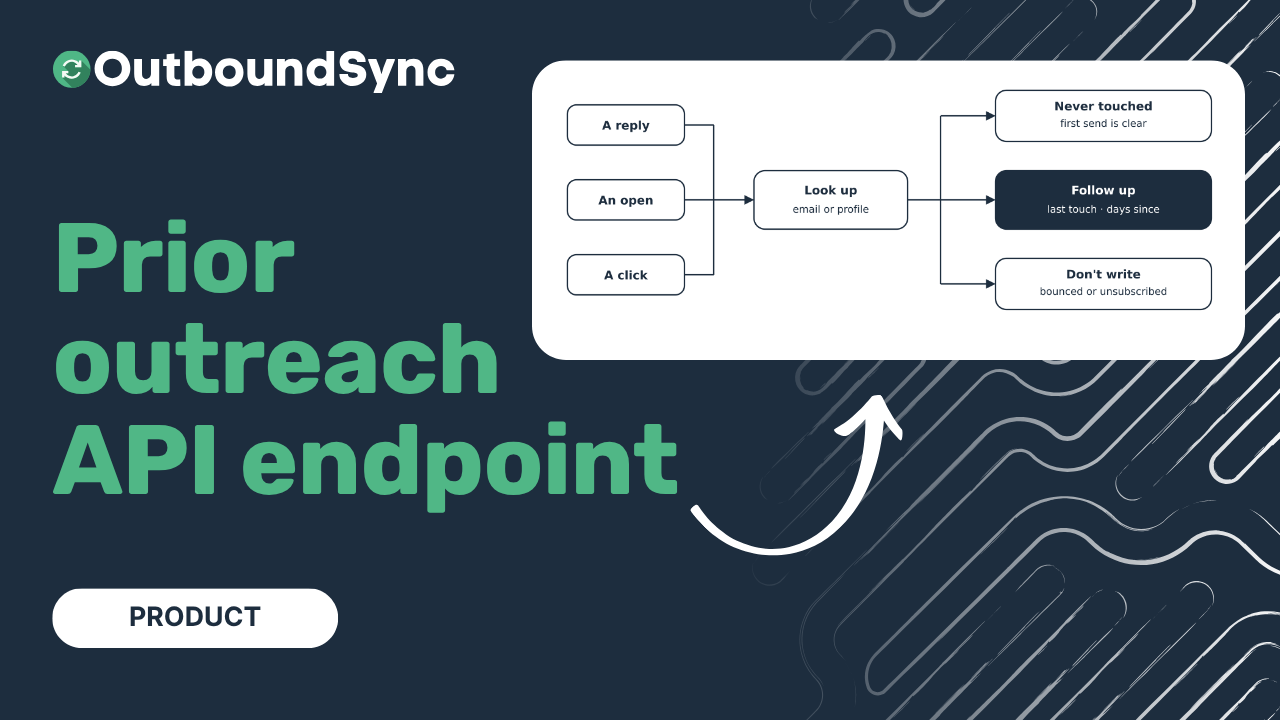
Prior Outreach Lookup API
Look up a contact's last outbound touch by email or social profile. Days since, bounce or unsubscribe, the history we logged, and which platform. Public beta.
Harris Kenny