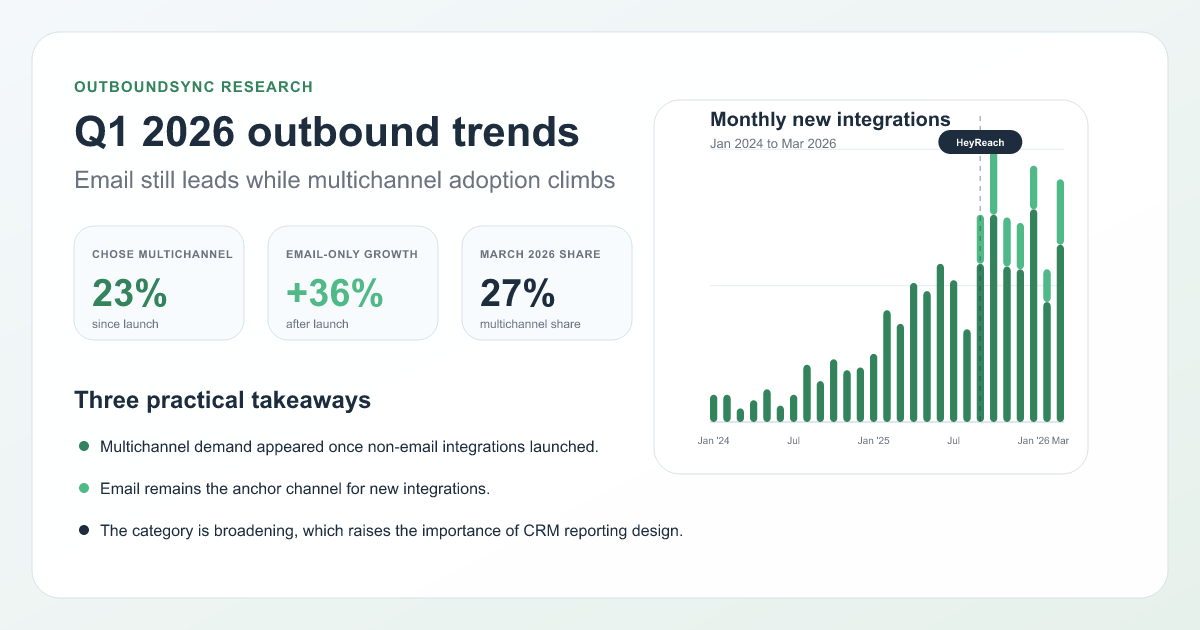
Q1 2026 outbound trends: Email still leads while multichannel adoption climbs
Email still anchors the modern outbound stack, but the data now shows a clear shift: teams are increasingly adding multichannel tools on top of that foundation.
Looking at OutboundSync customer integration data through March 31, 2026, the pattern is not one of rotation away from email. It is expansion. Multichannel adoption is real and growing, but email remains the base layer that most teams still build around.
This analysis is based on OutboundSync customer integrations connecting sales engagement platforms to HubSpot and Salesforce, covering October 2023 through March 31, 2026.
What the data shows
Three figures stand out from the Q1 2026 dataset:
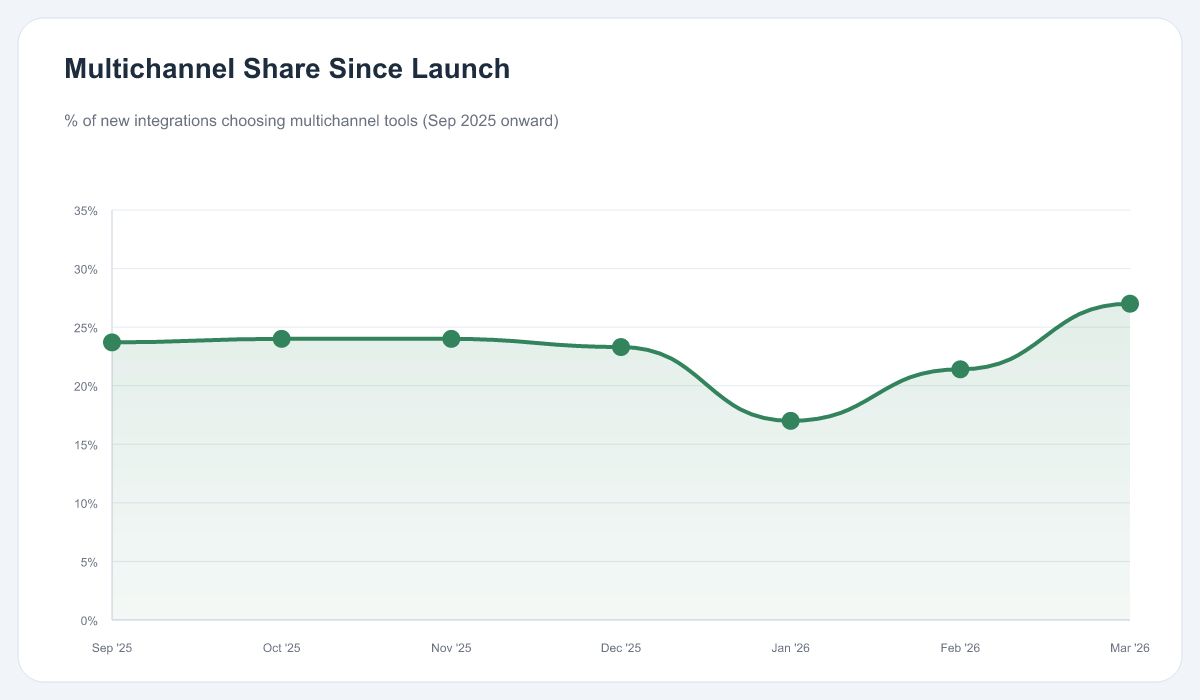
- 23% chose multichannel since multichannel integrations became available
- +36% growth in email-only integrations since multichannel launched
- 27% of new integrations were multichannel in March 2026, up from 24% at launch
Taken together, those numbers point to an additive market. Teams are not abandoning email. They are extending outbound programs with additional channels where it makes sense.
Three takeaways from the data
1. Multichannel demand appeared immediately
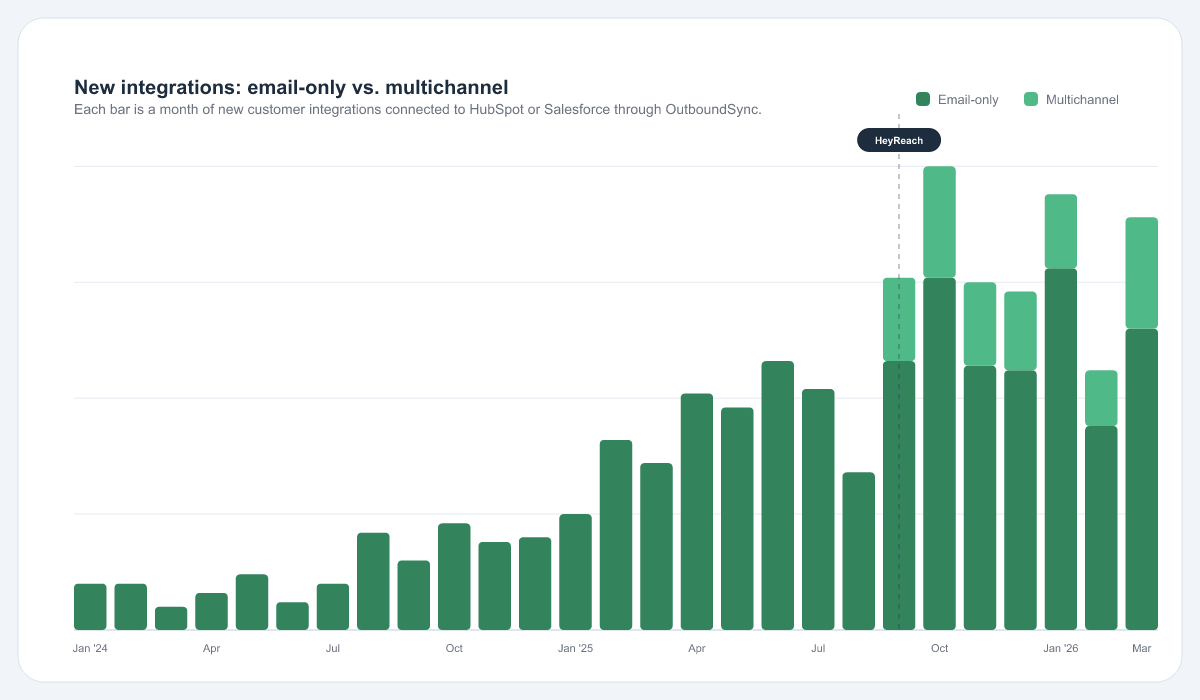
When the first non-email integration arrived, multichannel adoption showed up right away. At launch, roughly 24% of new integrations chose the new multichannel option. That matters because it suggests teams did not need to be convinced that additional channels were useful. The demand was already there.
In practical terms, the market signal looks more like delayed availability than slow education. Once the option existed inside the stack, a meaningful share of customers took it.
2. Email is still the operating system for outbound
The more important result may be what did not happen: email-only demand did not fall after multichannel became available.
According to the source analysis, email-only integrations are up 36% since multichannel launched. That supports a simple interpretation: for most teams, email remains the system that everything else wraps around. Social, inbox, and other mixed-channel workflows are being added to the motion, not replacing it.
That has implications for operators. If email is still the primary layer, then deliverability, mailbox strategy, CRM logging, attribution, and suppression logic still need to be designed around email first, even as the broader engagement mix expands.
3. The category is starting to diversify
The first wave of multichannel adoption was heavily associated with social-led tooling. By early 2026, the dataset starts to show a broader mix of tools entering the picture.
It is still early, and this is not a market-wide census. But the pattern is worth watching. Once a category moves beyond a single breakout product and begins to fragment into more specialized tools, the operational burden on GTM and RevOps teams tends to increase. Data models get messier. Reporting gets harder. CRM visibility matters more.
What this means for GTM and RevOps leaders
If you run outbound infrastructure, the takeaway is not just that more channels are showing up. It is that the stack is getting more layered.
- Plan for email to remain the anchor channel, even if your team expands into social or inbox workflows.
- Treat multichannel adoption as a reporting problem as much as a prospecting problem. If activity lands in different tools, your CRM and attribution model need to reconcile that.
- Expect integration quality to matter more as category diversity increases. More tools usually means more edge cases around identity, suppression, ownership, and handoff.
- Build the operating model before the stack sprawls too far. It is easier to add channels when lifecycle, routing, and measurement rules already exist.
The companies that benefit most from multichannel outbound will likely be the ones that make the stack legible inside the CRM, not just the ones that add more sending surfaces.
Methodology and caveats
This is OutboundSync customer-base data, not a market-wide census of all outbound teams or all sales engagement platforms.
Each record represents a customer connecting a sales engagement platform to HubSpot or Salesforce through OutboundSync. That means the data is useful for observing product adoption patterns within our customer base, but it should not be treated as a complete picture of the broader market.
Two additional caveats matter here:
- The reporting cutoff for this post is March 31, 2026. Any April 2026 or May 2026 channel launches are outside the scope of the core analysis.
- The source export used for the monthly chart begins in January 2024, even though the broader reporting window starts in October 2023.
Within those bounds, the directional signal is still clear: multichannel adoption is rising, and email continues to hold the center of gravity.
Frequently Asked Questions
What data is this analysis based on?
This post is based on OutboundSync customer integration data covering October 2023 through March 31, 2026. Each record represents a customer connecting a sales engagement platform to HubSpot or Salesforce through OutboundSync. It reflects OutboundSync’s customer base, not the entire outbound software market.
Does multichannel growth mean email is declining?
No. In this dataset, email-only integrations did not decline after multichannel options became available. The source analysis found that email-only integrations were up 36% after multichannel launched, which suggests teams are layering additional channels onto email rather than replacing email outright.
What counts as multichannel in this report?
For this analysis, multichannel refers to supported outbound tools available through March 31, 2026 that add channels or workflows beyond email, including the early social-led wave and other mixed-channel platforms in the reporting window. Later April and May 2026 launches are outside the scope of the core analysis.

Founder & President, OutboundSync
15+ years in B2B sales and operations. Former HubSpot Solutions Partner and Smartlead expert. Built the agency that became OutboundSync.